


Pignut Conopodium majus
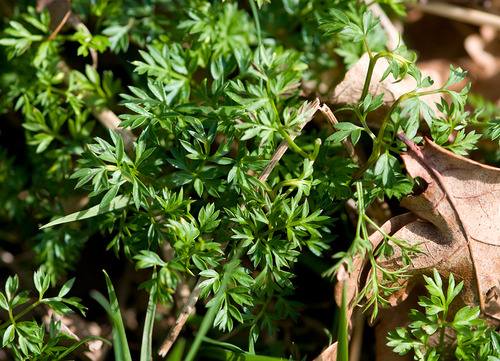
The pignut is a small elusive plant found in woodland, grasslands and ditch banks. Often found growing amongst bluebells. The pignut is a member of the umbelifer family which contains some very poisonous plants, such as hemlock Conium maculatum, and hemlock water dropwort Oenanthe crocata, all of which have the ability to kill you should you consume even a small amount. The pignut does look quite different, especially in size, but it’s always worth being shown the differences before even attempting to use a pignut as a food source.
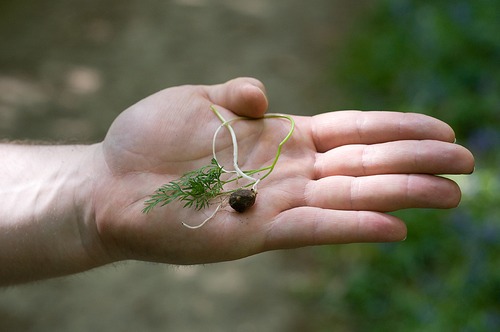
So why is the pignut called a ‘pig’ nut? Well, pigs love them and will root them up and eat them given half the chance, but the ‘nut’ part of the name comes from the small edible tuber which can be found at a 90 degree angle from the stem, about 2 inches below the earth. This root is often very small, but on occasions can grow to the size of a gold ball. They have a carrot-like taste with a peppery after-kick. I often time my springtime courses to coincide with these forgotten treats.
LEAVES - the small feathery leaves can be used in salads, or used to garnish savoury dishes.
ROOT – the single root is the main edible part, and is referred to as the nut, although it is in fact a tuber. Simply remove the leathery jacket to reveal the edible white inner part. I must mention here than when collecting the pignut take extra care to ensure that the root you find is indeed that of the pignut, and not from any other surrounding plants such as the bulb of the poisonous bluebell Hyacinthoides non-scripta.
CLICK HERE TO LEARN HOW TO FORAGE FOR PIGNUTS IN THE FORAGING TUORIAL
Tony on 22/05/12
Many thanks for the info on Pig nuts. I tried my first today. Many wild foods are "Edible" but you probably really wouldn't want to! These are very nice and I will be trying to spread them around some more. I had it raw rather than cooked and it reminded me of coconut.
Kris on 21/04/12
Julian, many thanks for the feedback, it’s always fantastic to hear from my readers, and I’m pleased it’s brought back some good memories! Let us all know how you get on finding some more. The next three weeks is the perfect time!
Julian Best on 21/04/12
What a great find it was when I Googled Pignut this morning. I was born in West Wales, and still live there, and only yesterday I was telling some friends of the pignut, but didn't know that that was what it was called, they had never heard of it anyway, so this morning I spent some time looking through a " Wild Flowers " book and found it, so it has taken me 78years to find out the name of what we as children used to call " Ground Nuts"
Many thanks for a very instructive site, got to go now as I want to see if I am still capable of finding some!!
Julian Best. Kidwelly.
Kris on 23/06/11
Audrey, thank you for your message. These sorts of things are being forgotten, so it's nice to hear that there are like-minded people who know what they are! Thanks for using the site :)
Audrey Grant on 21/06/11
I was so pleased to hear more about the pig nuts, as I used to eat them when i was very young( I am now aged 80!). Over the years I have tried to find other people who knew of them, but with no luck.We found them under a group of Fir trees, they were very easy to pull up, because of the light soil with the pine needles, so every Spring we had a very enjoyable feast!These were found at Hook Green in Kent, I often wonder if they are still to be found there.
Freya on 16/05/11
Remember as 'refugee' kids from Liverpool coming to live in wonderful hamlet in rural Yorkshire. Fields were our playground. Foraged for pig nuts. Can't recall who taught urban kids how to forage but we loved it. I now walk with a group who had never heard of them. Thanks for wonderful info to pass on to them.
catherine kirk on 24/07/10
i remember back in the fifties going walks with my dad and eating pignuts that he had found nobody i know had heard of them so decided to google pig nuts glad there was a website telling all about them brought back some great memories thanks






Vic on 28/05/18
Used to dig these up as a kid (and as an adult when I had the time). Always used to find them in woodland where it’s easy to dig in the leafmould. Have recently retired to North Wales where to my surprise I found them growing in the small paddock we have. Much different proposition to dig up as the grass is mostly a mat of Couch and Yorkshire Fog. Only tried one so far, very had work to get down through root mat and it was more like a very small sweet potato than the normal round shape. Could be I broke it before finding the “nut”.