


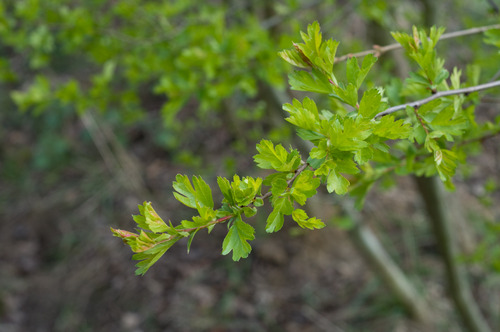
Hawthorn Crataegus monogyna
Hawthorn Crataegus monogyna has long been a favourite sign of springtime in Great Britain. Its pretty white flowers follow a flush of green leaves. Hawthorn has many local and country names, some of the most commonly heard are quick thorn, whitethorn, and most famously, the May tree, for its flowers traditionally appear in the month of May. Another name you will hear the hawthorn referred to is that of ‘bread and cheese tree’ which we will come to shortly. Hawthorn is a common hedgerow tree, often planted to create an impenetrable barrier for live stock. As the name suggests, it is covered in thorns, but they are not quite as vicious as those of the common Blackthorn Prunus spinosa.
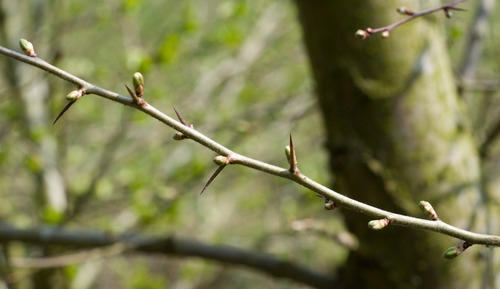
Hawthorn thorns
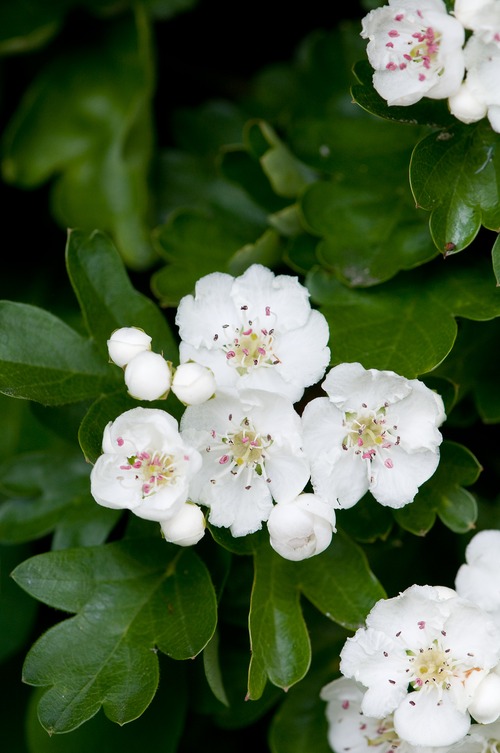
Hawthorn Flowers
LEAVES – the name ‘bread and cheese’ is referring to the leaves which have a nutty, and pleasant taste, as long as they are very young when eaten.
BERRIES – Late in the year you will notice lots of red berries appear on the hawthorn. These berries are known as ‘haws’. Birds will feed on these through the winter, and so can we, although they don’t really taste very much, and are dominated by a stone, which must not be cracked so be sure to spit it out! The stone is often made up of several segments which tend to fuse together to appear as one. The berries are mostly used to make jams, and fruit leathers.
SEEDS – the seeds should not be cracked when eating the flesh of the berry, but they can be roasted and ground into a coffee substitute.
M J Fowler on 02/05/16
The hawthorn leaves don't really taste of much, but a few chopped wild garlic leaves added make a very decent sandwich filling.
Phil H on 26/09/10
To us, in our neck-of-the-woods, bread and cheese refers to the sandwhich made using the leaves as the bread and the berry as the cheese. Hence the berry brings the texture and the leaves the flavour. Nature's deli.






Bren on 03/04/22
Beautiful writing and images about the Hawthorn. This tree is going NUTS in my Ohio wood land area of the property. I must say that they blooms are beautiful in the spring. The leaves of this tree actually saves many of my fruit trees from the deer. Those critters munch away on the hawthorn rather than my pluots. Great to connect!